

The Home of Authoritative Academic Works
Publishing exceptional hardcover editions for the academic community.
Welcome to Publish or Perish, Inc.®, an academic publisher—often known simply as Publish or Perish—dedicated to producing high-quality, authoritative texts for the educational community. We partner with authors and leverage our in-house production to create exceptional hardcover books. When you purchase from us, you are guaranteed an authentic, publisher-direct edition.
News & Announcements
View all-

The Epsilon-Delta Definition of a Limit, Finall...
Why does the epsilon-delta definition of a limit feel so opaque at first? A plain-language walkthrough of what it really says, a worked example, and why the rigor is worth...
The Epsilon-Delta Definition of a Limit, Finall...
Why does the epsilon-delta definition of a limit feel so opaque at first? A plain-language walkthrough of what it really says, a worked example, and why the rigor is worth...
-

The Three "Hard" Theorems Hiding in Every Calcu...
Some facts about continuous functions look too obvious to need proving. Spivak devotes an entire chapter to proving them anyway — and the payoff includes why every positive number has...
The Three "Hard" Theorems Hiding in Every Calcu...
Some facts about continuous functions look too obvious to need proving. Spivak devotes an entire chapter to proving them anyway — and the payoff includes why every positive number has...
-

Requesting a Desk or Examination Copy: Now Easi...
We've relaunched our desk and examination copy request process for instructors — one form, clear verification steps, and support for both digital and physical copies.
Requesting a Desk or Examination Copy: Now Easi...
We've relaunched our desk and examination copy request process for instructors — one form, clear verification steps, and support for both digital and physical copies.


The Publish or Perish Standard
High-Standard Hardcover Editions
Every book is printed in-house on premium paper, adhering to our rigorous publishing standards. We personally inspect each copy for zero visible defects before it is packed.
Talk Directly to the Publisher
Skip the call center and automated messages. When you contact us, you’re talking directly to the people who print and pack your book—we are here to help you.
Featured products
-
A Comprehensive Introduction to Differential Geometry, Vol. 1, 3rd Edition by Michael Spivak | Publish or Perish
Regular price $112.99 USDRegular priceUnit price per -
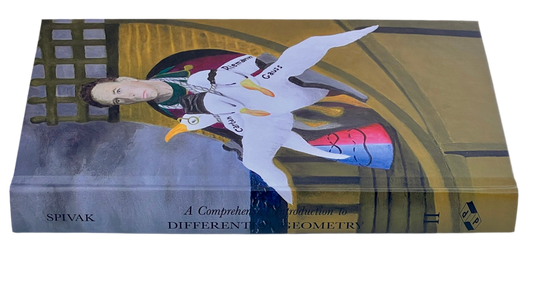
A Comprehensive Introduction to Differential Geometry, Vol. 2, 3rd Edition by Michael Spivak | Publish or Perish
Regular price $94.99 USDRegular priceUnit price per -
A Comprehensive Introduction to Differential Geometry, Vol. 3, 3rd Edition by Michael Spivak | Publish or Perish
Regular price $94.99 USDRegular priceUnit price per$0.00 USDSale price $94.99 USD -
A Comprehensive Introduction to Differential Geometry, Vol. 4, 3rd Edition by Michael Spivak | Publish or Perish
Regular price $103.99 USDRegular priceUnit price per$0.00 USDSale price $103.99 USD






This structured data helps search engines understand your organization better. The actual JSON-LD markup is embedded in the page head and is invisible to visitors.